
Indian wedding invitations carry a special kind of anticipation. They often introduce not just a ceremony, but a sequence of gatherings—colors, music, family, and celebration unfolding across days. The design has to feel generous and clear at the same time.
Indian weddings vary widely by family, region, religion, and celebration style, so there is no single "correct" look. What follows focuses on invitation design and communication: rich visual storytelling, florals and palace-inspired details, modern versus traditional-looking layouts, and how to keep multi-event logistics readable. You will find inspiration you can adapt—whether you lean ornate or clean—and paths into digital wedding invitations and video formats that travel easily to guests near and far.
Start With the Story Your Invitation Should Tell
Before choosing motifs, decide what guests should feel in the first three seconds. Some couples want ceremonial grandeur—arches, draped florals, jewel light. Others want a quieter modern frame with one strong cultural accent. Both can be beautiful. The invitation succeeds when that first impression matches the energy of your events.
Ask a few practical design questions early:
- Will one primary invite cover everything, or will you send a suite (ceremony, reception, additional gatherings)?
- Do guests need travel and dress guidance at a glance?
- Is the aesthetic more palace-ornate, floral-romantic, or contemporary minimal with warm accents?
Those answers shape color, density of ornament, and how much text the design can hold. A multi-day celebration usually needs clearer information hierarchy than a single evening event—beautiful borders should never hide the schedule.
Color, Florals, and Palace-Inspired Detail
Rich color is one of the most recognizable strengths in many Indian wedding invitation aesthetics. Red, rose, and deep jewel tones paired with gold create warmth and ceremony. Soft rose-pink and champagne can feel equally celebratory when the florals and architecture carry the grandeur. Choose a dominant hue, a metallic or warm accent, and a light field for type so names and dates stay crisp on a phone screen.
Floral framing works beautifully when it behaves like architecture: garlands as borders, blooms anchoring corners, petals suggesting movement without covering the words. Palace-inspired details—arched windows, carved jharokha-like frames, reflective water, illuminated courtyards—add depth and scale. Use them as atmosphere, not as a checklist of motifs to crowd into every inch.
For couples who also love broader high-end polish (deep sapphire evenings, estate formality), luxury wedding invitations explores that adjacent visual language. If your mood is softer candlelight and blush romance without a specifically Indian frame, romantic wedding invitations may fit as a complementary direction.
Modern Layouts vs. Traditional-Looking Design
You do not have to choose between "fully ornate" and "fully minimal." Many of the strongest Indian wedding invitations today blend both: a clean typographic center with a richly illustrated border, or a contemporary photo-led opening that settles into classic gold-and-floral framing.
More traditional-looking designs often emphasize ornate borders, dense floral patterns, and ceremonial color. They shine when the text block is still disciplined—names large, event details in a clear secondary structure.
More modern designs may use larger photography, simpler geometric frames, or generous negative space, then introduce one or two culturally resonant accents (a floral arch, a warm metallic line, a palace silhouette). Modern does not mean cold; it means edited.
Either way, test readability. Guests should find date, venue, and RSVP path without hunting through decoration. If you are exploring formats beyond a static card, how to make digital invitations covers practical setup steps that apply well to ornate and modern styles alike.
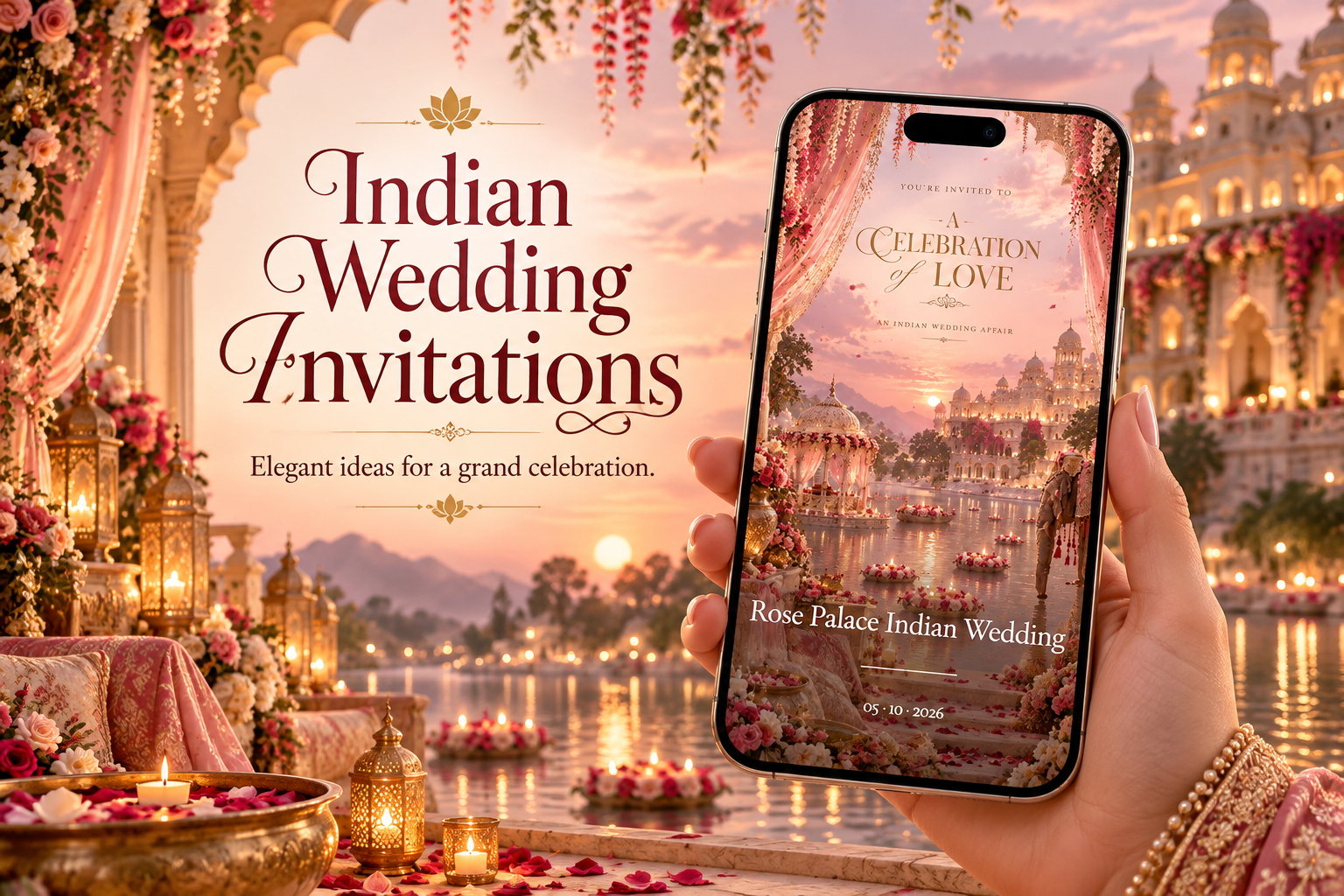
Featured TwistInvite DesignRose Palace Indian WeddingRose pink and gold open onto an Indian palace setting with floral draping and waterfront light, creating a ceremonial, romantic, and grand visual direction without visual clutter.Explore Wedding InvitationsMulti-Event Clarity: Ceremony, Reception, and Beyond
When celebrations span more than one gathering, the invitation becomes a small information system. Guests need to know which events they are invited to, where to be, and how formal each moment feels—without receiving a wall of undifferentiated text.
Design approaches that keep ornate invites usable:
- Primary invite + supporting cards or screens for additional events
- Clear event headers (ceremony, reception, and any other gatherings you include) with time and location under each
- A short dress or attire note when expectations differ across events
- One obvious RSVP path so guests are not guessing how to reply
Wording should stay warm and precise. Host lines, event names, and travel notes benefit from examples you can adapt—see wedding invitation wording examples. Avoid packing every cultural detail into the invite itself; the design can suggest celebration while the text stays focused on who, what, when, where, and how to respond.
Digital and Video Invitations for Indian Weddings
Digital and video formats are especially practical when families and friends are spread across cities or countries. A well-paced wedding invitation video can open on florals or palace architecture, settle on the couple's names, then reveal key events in calm sequence. Subtle motion—soft light across a border, petals, lantern glow—supports grandeur better than rapid cuts.
On TwistInvite, couples create mobile-first digital and video invitations, add their own media where supported, and track RSVPs with Going / Can't make it / Maybe—guests reply without creating an account. That simplicity helps when you are coordinating many people across time zones. Explore TwistInvite wedding invitation designs when you are ready to compare ornate and modern templates side by side.
Share via text or link so the invite meets guests where they already are. Keep logistics large enough to read on a phone, even when the frame is richly decorated.
Frequently Asked Questions
Do Indian wedding invitations need to follow one specific style?
No. Indian weddings vary widely by family, region, religion, and celebration style. Choose colors, ornament, and layout that match your events rather than a single assumed template.
How do I show multiple events without overcrowding the design?
Use clear event headers, consider a primary invite plus supporting cards or screens, and keep one obvious RSVP path. Ornament belongs in the frame; the schedule needs hierarchy.
What colors work well for Indian wedding invitation designs?
Red, rose, jewel tones, and gold are classic pairings; rose-pink and champagne can feel equally grand with strong florals and architecture. Lock a dominant color, an accent, and a light field for readable type.
Can digital Indian wedding invitations feel traditional and elegant?
Yes. Traditional-looking borders, florals, and palace-inspired atmosphere translate beautifully to digital and video when motion stays subtle and text remains clear.
Should every cultural detail appear on the invitation?
Not necessarily. Let the design suggest celebration and keep the written content focused on guests' practical needs—events, timing, location, attire notes, and RSVP. Deeper ceremony context can live on a wedding website or in family communication.
Where should I start if I want a modern look with cultural warmth?
Begin with a clean typographic center and one or two resonant accents—floral arch, warm metallic framing, architectural silhouette—then test readability on a phone before adding more detail.
Decide first whether your invitation should feel richly ceremonial, quietly modern, or somewhere between—and design every color and line to support that choice. When the mood and the schedule are both easy to read, guests arrive already part of the celebration.
Create it in the TwistInvite app
Download free on iPhone or Android, then share one link with your guests.