
Dinner party invitation wording should tell guests what kind of night they’re walking into. An intimate kitchen supper and a formal seated dinner need different language—and both need clear time, place, and RSVP details. Write for the evening you’re actually hosting, not the evening you wish you had the budget for.
Use the examples below as starting points for elegant, casual, modern, birthday, and shared-supper evenings. For the planning hub, see dinner party invitation ideas and wording. For visuals, browse dinner party invitation templates.
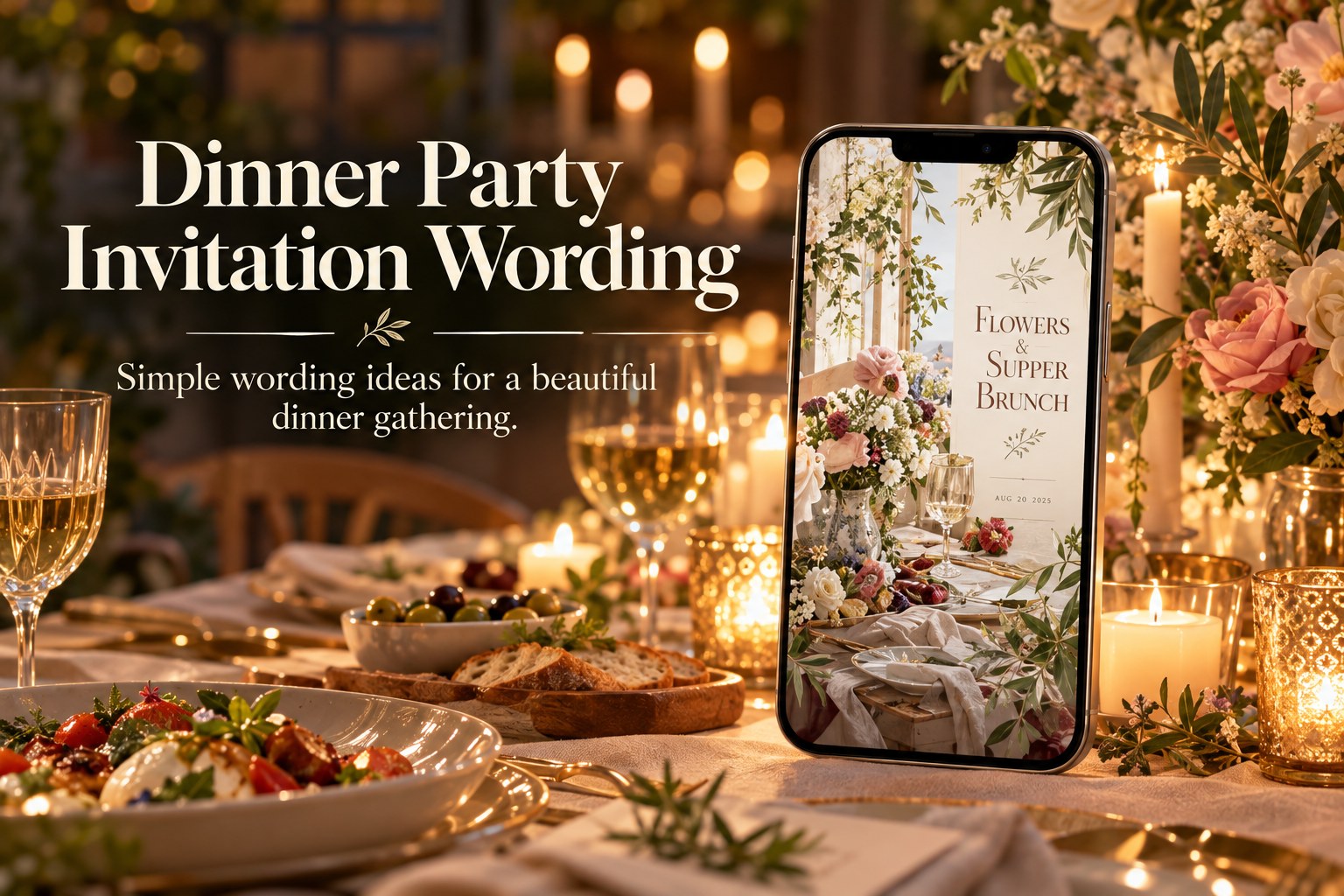
The Structure That Always Works
Open with the invitation line, then host, occasion (if any), date, arrival vs. seating time, location, dress, menu note, and RSVP. Dinner invitation wording fails when seating time is missing or plus-ones are unclear. Guests will invent answers if you don’t provide them—and invented answers create awkward arrivals.
Host scenario: you write “Dinner Saturday!” and mean cocktails at 6:30 with seating at 7:15. Two friends arrive at 6:05 into unfinished prep; two more stroll in at 7:20 during the first course. Listing both times on the invitation prevents that split.
Keep quotes and flourishes optional. A single warm sentence beats a paragraph of filler. On digital invites, put logistics where a thumb can find them without pinch-zooming a poem. Proof names and addresses twice; wording charm won’t fix a wrong unit number.
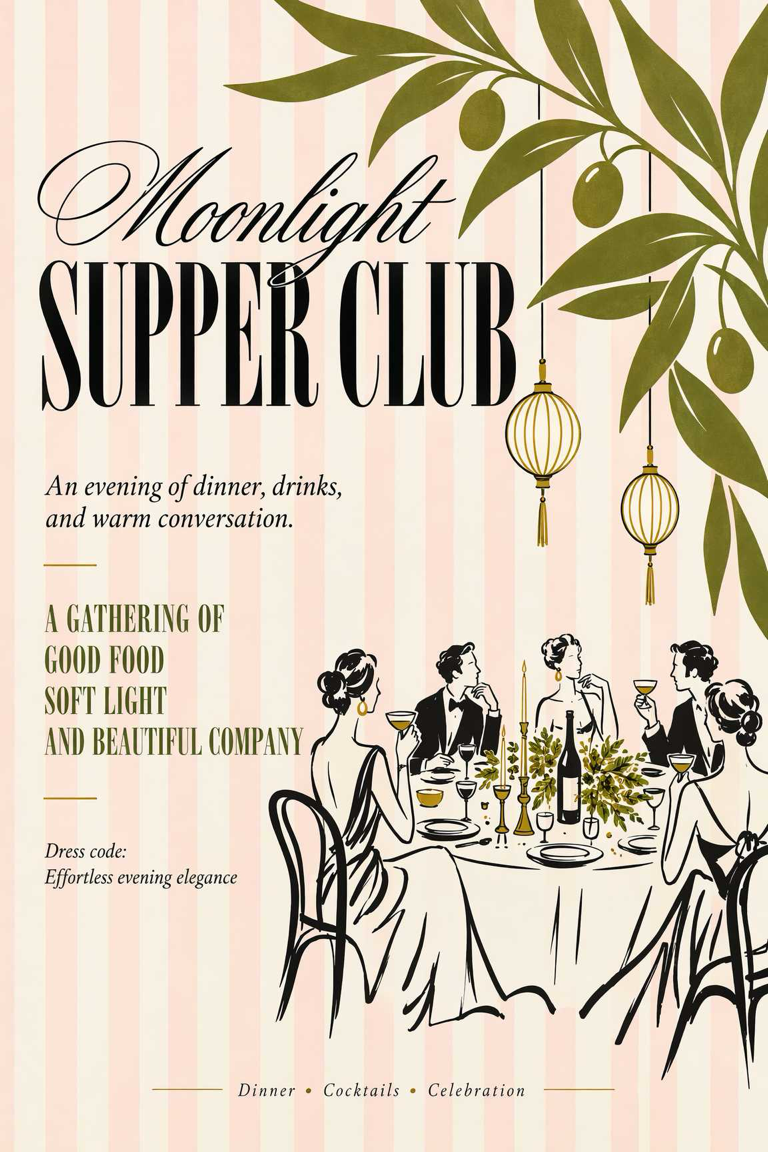 Featured TwistInvite DesignMoonlight Supper ClubAn evening of dinner, drinks, and warm conversation—a supper-club design that pairs well with polished dinner party invitation wording.Explore Invitations
Elegant Dinner Party Wording
Please join us for dinner.
Saturday, October 11 · Cocktails at 6:30 PM · Dinner at 7:15 PM
[Address]
Cocktail attire. Kindly RSVP by October 4 and share any dietary notes.
We request the pleasure of your company for an evening dinner.
[Date] · [Time] · [Venue]
Seating is limited; please reply for [number] guest(s).
You’re invited to a seated dinner hosted by [Host].
[Date] · Arrival [time] · Dinner [time]
Soft formal attire. Please RSVP by [date].
Casual Dinner Invite Wording
Come for dinner Saturday—nothing fancy, just good food and a long table.
6:00 PM at our place. Bring a bottle if you want; otherwise just bring yourself. RSVP by Thursday?
Dinner at ours this Friday. Tacos, playlists, and early enough that you can still have a weekend. Reply Going, Can’t make it or Maybe.
Kitchen dinner for friends.
[Date] · 7:00 PM · [Address]
Come comfortable. Kids’ bedtime friendly—we’ll eat on time.
Modern and Intimate Wording
You’re invited to an intimate dinner for eight.
[Date] · Arrival 7:00 PM
[Place]
Smart casual. We’ll cook; you bring conversation. Please RSVP by [date].
Small dinner, big catch-up.
[Date] · [Time] · [Address]
Adults only this time—thanks for understanding. RSVP link inside.
Dinner for a few of our favorite people.
[Date] · Seating at 7:30 PM
Limited seats—please reply promptly.
Birthday Dinner Wording
Celebrate [Name] at a birthday dinner.
[Date] · [Time]
[Restaurant or home address]
Dress: smart casual. Please RSVP by [date] so we can finalize the headcount.
Birthday dinner for [Name]—private dining room, cake to follow.
Plus-ones welcome; reply with names.
Milestone birthday dinner.
[Date] · Cocktails [time] · Dinner [time] · [Place]
Our treat tonight. No gifts, please.
More birthday logistics live on birthday dinner invitations. Keep deep birthday dinner planning there; this guide covers wording for every other kind of dinner.
Formal Dinner Wording
You are cordially invited to dinner hosted by [Host].
[Date] · Reception at [time] · Dinner at [time]
[Venue]
Black-tie optional. Kindly respond by [date].
Please join [Host] for a formal evening dinner.
[Date] · [Time] · [Place]
Attire: black tie. RSVP essential for seating.
Use formal wording sparingly—match it to a truly formal table, not a weeknight pasta night. Mismatched formality feels colder than casual language at a fancy venue.
Potluck / Shared Dinner Wording
Supper club night—everyone brings a dish.
We’ll cover the main and drinks. Text me your dish category (starter, side, dessert) so the table stays balanced.
Shared dinner at [Place].
Host provides entrée; guests bring sides or wine. Dietary needs? Just let us know.
Potluck dinner to celebrate [occasion].
[Date] · [Time] · [Address]
Text me which category you’re taking—no duplicate desserts if we can help it.
Attire, Menu, and RSVP Lines
Attire
- “Cocktail attire”
- “Smart casual—jackets welcome”
- “Come comfortable; kitchen dinner”
- “Dressy evening”
- “Black-tie optional”
Menu
- “Plated dinner”
- “Family-style feast”
- “Light bites and dessert”
- “Full dinner—no need to eat beforehand”
- “Tasting menu; please arrive on time”
RSVP
- “Please RSVP by [date].”
- “Reply Going, Can’t make it, or Maybe.”
- “Let us know about any allergies.”
- “Plus-ones kindly decline this time—table is set for listed guests.”
Digital dinners pair well with online invitations with RSVP and the video invitation maker. Wedding-weekend evenings that are rehearsals belong on rehearsal dinner invitations. Ready to send yours? Our dinner invitation maker lets guests RSVP from the same link.
Quotes and One-Liners (Optional, Not Required)
A short line can warm a modern invite—“Good food, better company,” “Save us a seat at your stories,” “Dinner is the plan; conversation is the point.” Use one, not five. Dinner party invitation quotes should support the logistics, not replace them.
When a quote helps: intimate dinners among friends, modern minimal templates with spare type, hosts who dislike stiff formality. When to skip: formal black-tie optional evenings, multi-generational seated dinners where clarity beats cleverness, any layout already crowded with florals and a long address. If a quote fights your typography or makes the time harder to find, cut it. Guests remember the seating time longer than the epigraph.
When Elegant vs. Casual Dinner Wording Is the Right Call
Choose elegant wording when seating is timed, dress is elevated, or the venue is a private dining room. Choose casual wording when the kitchen is the dining room and arrival is flexible. The mismatch that stings most is formal prose for a taco night—or slang on an invite to someone’s boss and in-laws at the same table. If your guest list spans both worlds, aim for warm plain English with clear times: polished enough for elders, human enough for friends.
Common Mistakes in Dinner Invite Copy
- Listing only “Saturday night” without a clock time
- Skipping plus-one rules on a fixed table
- Using formal language for a casual kitchen dinner (or the reverse)
- Hiding the address under a long story
- Forgetting to ask about dietary needs when the menu is set
Fix those before you hunt for a cleverer opening line.
Frequently Asked Questions
What’s the difference between arrival time and seating time? Arrival is when guests should show up; seating is when dinner starts. List both when cocktails or mingling come first.
How formal should dinner invitation wording be? Match the evening. Formal language for formal tables; warm plain English for kitchen dinners.
Should I mention who is paying at a restaurant birthday? When it affects guest comfort, yes—a short “our treat” or “we’ll settle as a group” line prevents awkwardness. Customs vary; clarity helps.
Can I reuse brunch wording for dinner? Swap meal cues, times, and dress notes. Evening logistics differ enough that a straight copy-paste usually feels wrong.
When your wording feels settled, preview the full invite on your phone one more time—logistics first, warmth second, clutter nowhere. Choose the tone that matches your table, lock the seating time, and send while guests still have room on their calendars.
Create it in the TwistInvite app
Download free on iPhone or Android, then share one link with your guests.