
If you are planning your wedding digitally, it is easy to wonder whether you really need both a save the date and a wedding invitation. After all, if both arrive as a link on someone’s phone, are you basically sending the same thing twice?
Not quite. A save the date asks guests to keep the day free, while a wedding invitation gives them the full celebration details and asks them to respond. The format can be paper or digital, but those two jobs stay different. Your save the date is the first heads-up; your invitation is the moment when the wedding becomes real enough for guests to make a decision.
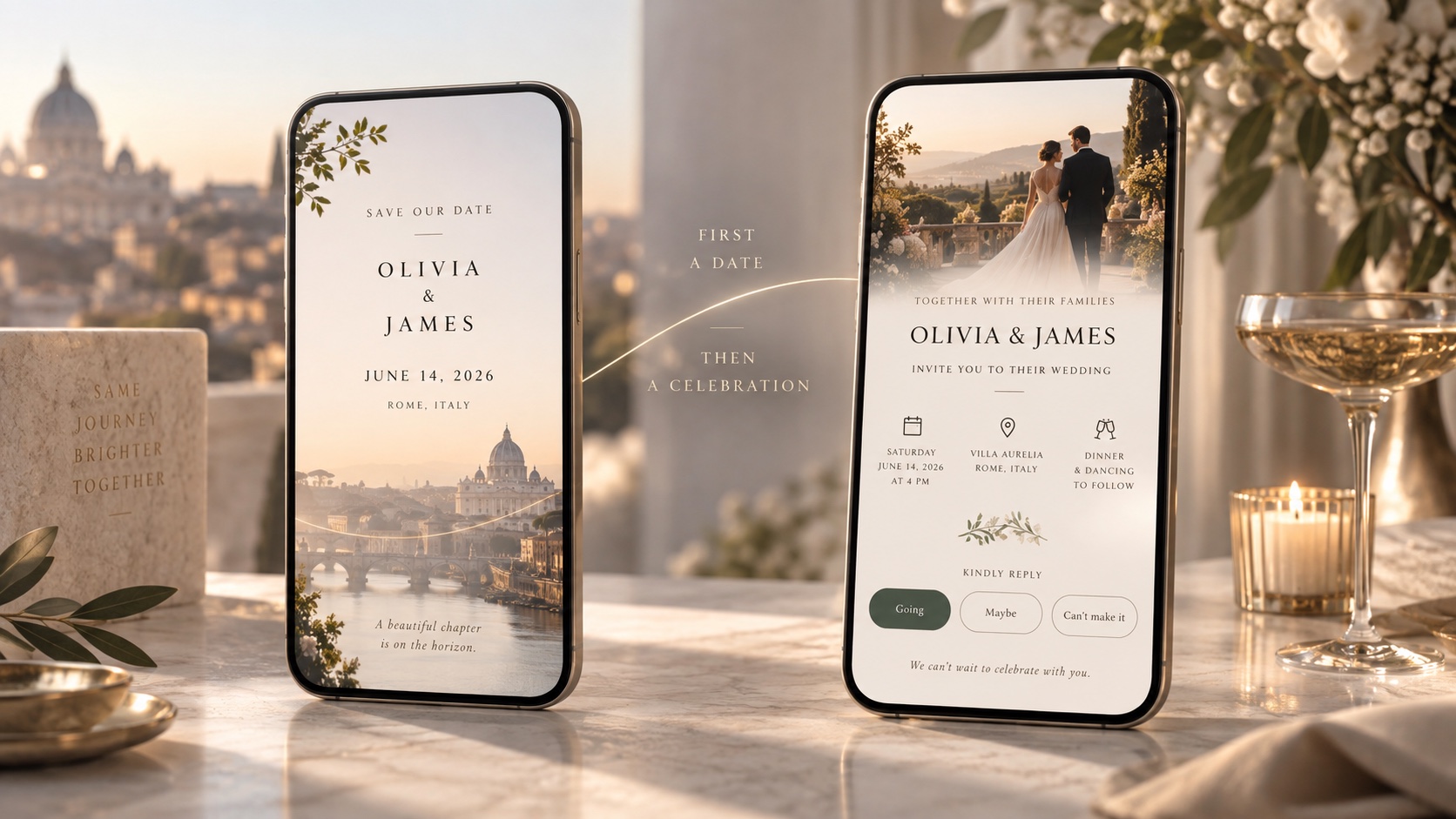
Quick Answer: Save the Date vs Wedding Invitation
A save the date gives guests advance notice so they can keep the day open. A wedding invitation formally invites them to attend, gives them the confirmed time and venue, and normally includes RSVP. You always need an invitation; a separate save the date is optional.
Save the Date vs Wedding Invitation: Two Different Jobs
A save the date is advance notice. Its job is simple: tell the people you expect to invite that your wedding is happening on a particular date so they can keep that day open. At that point, you may know the wedding date and city but still be confirming the exact venue, schedule, dress code, or other logistics. That is fine because a save the date does not need to carry the entire wedding plan.
A wedding invitation comes later and does a different job. It is the formal invitation to attend, with the information guests need to show up and respond: the date, time, venue, relevant event details, and RSVP instructions. A save the date is not a substitute for the formal invitation, so anyone who receives one should also receive the invitation later.
| Difference | Save the Date | Wedding Invitation |
|---|---|---|
| Main job | Ask guests to keep the date open | Formally invite them to attend |
| Information | Names, date, general location | Full date, time, venue, and event details |
| RSVP | Usually no | Yes |
| Timing | Earlier | Later |
| Tone | First hint of the wedding | Full invitation experience |
| If digital | Shorter, lighter, simpler | More complete, with RSVP |
Both can be beautiful, and both can be digital. They simply should not be doing exactly the same job.
What Goes on Each One?
A good save the date is intentionally incomplete. Guests usually need your names, the wedding date, and the city or general location. If you have a wedding website, you may also include its main link and a simple line such as “Invitation to follow.” That is enough to help someone check their calendar, think about travel, and understand that more information will come later.
You normally do not need to squeeze the exact ceremony time, full venue address, meal choices, dress code, RSVP deadline, and every other detail onto the save the date. Those belong to the formal invitation stage. Wedding-etiquette guidance also generally keeps registry information off both cards and directs guests to the wedding website instead.
The formal wedding invitation is where the picture becomes complete. Guests should receive the confirmed time and venue, any important reception or dress details, and a clear way to RSVP. If your venue is not finalized when you are ready to send the save the date, a firm date and general location can be enough. It is better to give guests a smaller amount of confirmed information than a fuller set of details that may change.
Do You Actually Need Both?
You always need an invitation, but a save the date is optional. Whether you need the earlier message depends mostly on how much advance notice your guests require. If people need to book flights, request time off, arrange childcare, travel during a busy holiday period, or plan around a destination wedding, the early notice is genuinely useful.
For a short engagement, a very small local wedding, or a casual celebration where almost everyone already knows the date, a separate save the date may add very little. In that case, it is often cleaner to send the formal invitation early rather than send a save the date and follow it almost immediately with another message. If you send only one thing, it should function as the invitation, not as a save the date that never gets followed by the real invitation.
Once save the dates have gone out, do not send one casually to someone unless you genuinely intend to invite them. Asking a guest to reserve the day creates a clear expectation that the formal invitation will follow. For broader questions about formality and guest expectations, read our guide to whether digital wedding invitations are appropriate.
If Both Are Digital, How Do You Keep Them From Feeling Repetitive?
If you mail a postcard first and a formal invitation suite later, the difference between the two objects is obvious. When both arrive as links, however, couples sometimes worry that guests will think they have already received the invitation. The solution is not to make one of them paper; it is to make the two digital experiences feel like two chapters rather than duplicates.
Your digital save the date can be lighter. It might use one strong photo, a short motion moment such as an animated save the date video, your names, the date, and the city. The formal digital invitation can then feel fuller, with a more developed visual treatment, richer photos or video, complete event details, and an online RSVP experience.
Think of them as sisters, not twins. They can share the same color palette, typography, photography style, or visual motif without being copies. A save the date can offer only a glimpse of the story, while the formal invitation reveals more through a fuller video, your own photos, a personal voice message, or another meaningful part of the celebration.
With TwistInvite, the later invitation can combine that fuller visual experience with RSVP. Guests can see the event details and choose Going, Can’t make it, or Maybe without creating an account. Video is not required; the point is that the second message should feel like the wedding has moved forward.
Save the date
Remember this day.
The first chapter creates recognition and gives guests time to plan.
Create it in the TwistInvite app
Download free on iPhone or Android, then share one link with your guests.
Wedding invitation
Here is the celebration.
The second chapter shares the full details and asks whether guests will be there.
Should a Save the Date Include RSVP?
Usually, no. Digital tools can blur this line because a platform may technically make an RSVP button available very early, but that does not mean guests should be asked for a formal attendance decision months before they have the full wedding information.
A save the date is advance notice, not normally a request for a final headcount. People’s plans can change, travel details may still be incomplete, and an answer given too early may not be reliable by the time you need catering or seating numbers. The formal invitation is the better place for RSVP because guests can decide with the confirmed venue, timing, and event information in front of them.
There are exceptions. A destination wedding may need an early sense of travel interest, a very small event may need earlier planning, or you may want to collect mailing addresses before sending paper invitations. Those are useful preliminary questions, but they are not necessarily the same as a formal wedding RSVP. If you ask “Thinking of joining us?” make it clear that the answer is an early temperature check rather than the final attendance count.
When Should Each One Go Out?
There is no single timing rule that every wedding expert agrees on, so ranges are more useful than pretending there is one perfect week. For a typical local wedding, save the dates are often sent roughly four to eight months before the wedding, with six to eight months appearing frequently in current guidance. Destination or travel-heavy weddings commonly receive more notice, often around eight to twelve months or more.
Formal wedding invitations are usually sent later. Around six to eight weeks is still a common traditional range, although some guidance recommends eight to twelve weeks, particularly when travel is involved. If you skipped the save the date, lean toward the earlier side of the invitation window rather than waiting until the last minute.
The reason for the two messages matters more than a single perfect date. The save the date gives people planning time. The invitation arrives when you have enough confirmed information to ask for a real response.
So Which One Do You Need?
If your wedding is far enough away that guests would benefit from advance notice, send a save the date first. Keep it simple with your names, date, general location, and a promise that the invitation will follow. Later, send the formal wedding invitation with the complete event information and RSVP.
If the wedding is coming up fairly soon, your guest list is small and local, or everyone already knows the date, you may not need the extra save-the-date step. Send the invitation early and let one message do the full job. Both messages can be digital; each one simply needs a reason to exist. Your save the date should feel like the first hint of the wedding, while your invitation should feel like the full experience.
Frequently Asked Questions
Is a save the date the same as a wedding invitation?
No. A save the date gives guests advance notice so they can keep the day open. The wedding invitation is the formal invitation to attend and normally includes the full event details and RSVP.
Do you send wedding invitations after save the dates?
Yes. Anyone who receives a save the date should also receive the formal wedding invitation later. The save the date does not replace it.
Do you need both a save the date and a wedding invitation?
You need a wedding invitation, but a save the date is optional. Save the dates are especially useful when guests need significant advance notice for travel, holidays, or busy schedules.
Should a save the date include RSVP?
Usually not. Formal RSVP normally belongs on the wedding invitation, once guests have the confirmed information they need to make a reliable decision. Early interest checks can be useful in some destination or unusual planning situations, but they should be clearly treated as preliminary.
Can both the save the date and wedding invitation be digital?
Yes. They can both be digital while still doing different jobs. Keep their visual identity related, but make the save the date lighter and the invitation more complete.
What should go on a digital save the date?
Usually your names, wedding date, city or general location, and a line such as “Invitation to follow.” A wedding website link or photo can also be included if useful.
What if the venue is not confirmed yet?
If the wedding date is firm, you can usually send the save the date with the city or general location and leave the exact venue for the formal invitation.
Can I skip the save the date and send only one digital invitation?
Yes, particularly for a short engagement, small local wedding, or when guests already know the date. In that case, send the formal invitation early rather than treating the save the date as the only invitation.
Should my digital save the date and invitation match?
They can coordinate without being identical. Sharing colors, type, imagery, or a visual motif can make them feel connected while still allowing the formal invitation to feel like a meaningful next chapter.
Does a destination wedding change the difference?
The jobs remain the same, but destination weddings usually require more lead time. The save the date helps guests start planning travel earlier, while the formal invitation later provides the confirmed details and RSVP.
Two Messages, One Wedding Story
A save the date and a wedding invitation are not redundant just because both are digital. One gives your guests time; the other gives them the wedding. Use the first to say, “Keep this day open,” and the second to say, “Here is everything you need, and we hope you’ll be there.”
If you are ready for that second chapter, explore wedding invitations or read our guide to creating, sending, and collecting RSVP with a digital wedding invitation.