
Queer community events can take many forms: picnics, dinners, art nights, markets, workshops, meetups, socials, dances, book clubs, outdoor gatherings, or something that does not fit neatly into any traditional event category.
That variety is exactly why the invitation needs to be clear.
Someone seeing the event for the first time should understand what kind of space it is, whether they can come alone, what they will actually do there, and whether the event feels like somewhere they would be comfortable spending time.
A queer community invitation is not just promotional material. It is the first signal of what kind of experience the organizer is creating. You can also start from one of our LGBTQ+ invitations and send it as a single link.
Start With a Clear Description of the Event
A clever event name can be fun, but it should not replace a useful description.
“Open Circle” might sound beautiful, but a new guest still needs to know whether it is a picnic, discussion group, social night, or workshop.
A clear description might say:
A relaxed outdoor social for queer people, friends, and community, with food, conversation, and plenty of room to meet new people.
That sentence immediately lowers uncertainty.
Queer Community Event Invitation Wording
Warm, direct language works well.
For an open social:
Come as you are. Stay for the people you meet.
For a community picnic:
Food, sunshine, conversation, and a little more room to find your people.
For a creative event:
Make something, meet someone, and spend the afternoon with the community.
For guests attending alone:
Coming solo? You will not be the only one.
That last line can be especially valuable because many people hesitate to attend community events when they do not already know anyone there. There’s also a separate guide to Pride bike ride invitations for community rides and outdoor events.
What Information Should Organizers Include?
In addition to date, time, location, and RSVP, consider whether guests need to know:
- age range or age restrictions
- accessibility
- venue type
- alcohol policy
- entry cost
- registration requirements
- whether friends or partners are welcome
- whether photography will take place
- whether the event is indoors or outdoors
Not every event needs all of these details.
The goal is to remove the uncertainties that materially affect someone’s decision to attend.
Queer Community Event Design Ideas
Queer events do not need one visual language.
Design can come from:
- editorial photography
- collage
- hand lettering
- photocopy or zine textures
- folk illustration
- bright block color
- minimal typography
- candid community scenes
- restrained Pride accents
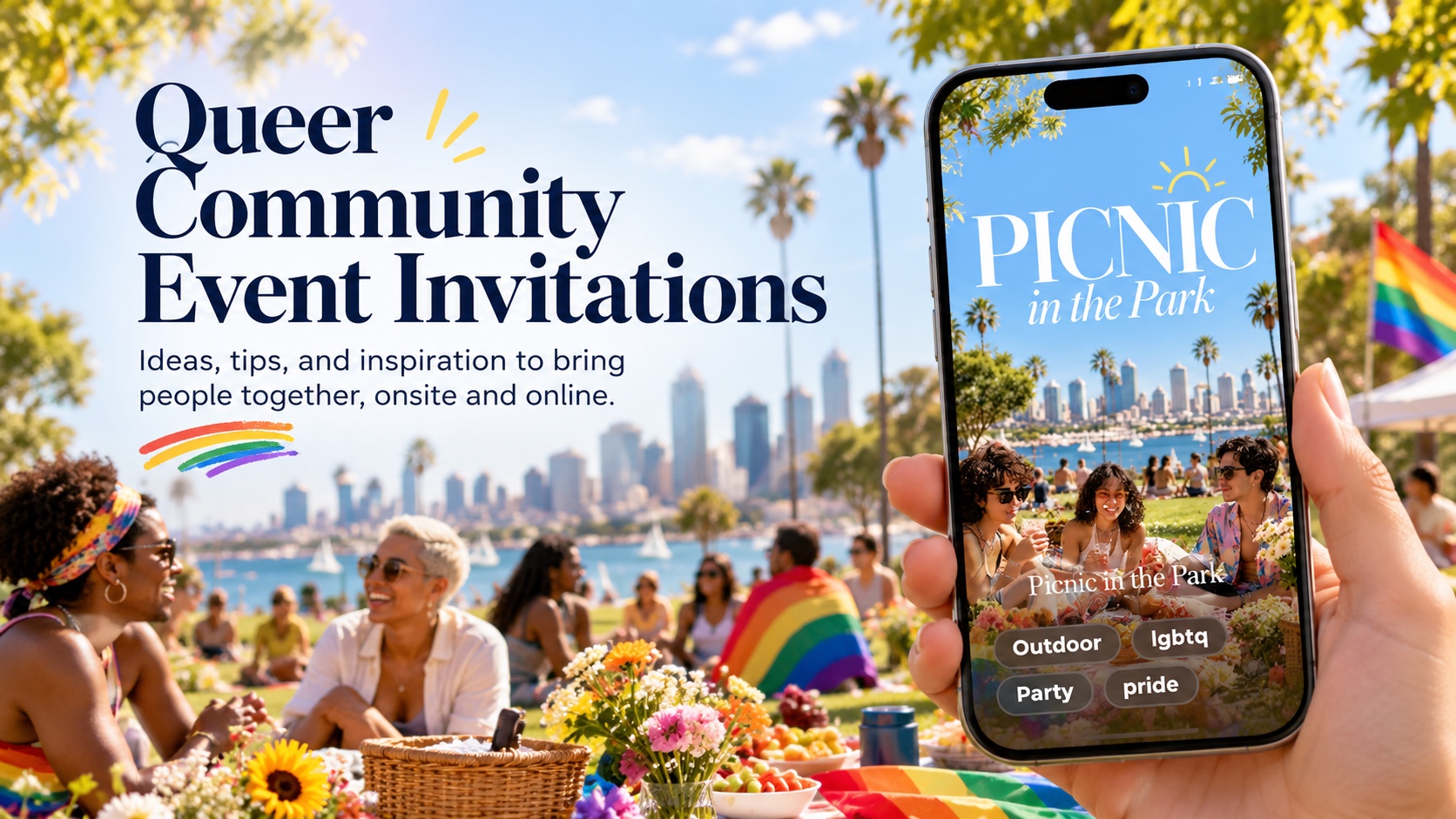
The Picnic in the Park direction works because the people and setting carry the image. The rainbow identifies the community, but it does not have to do all the work.
This is a useful principle for community design in general: show the experience, not only the label.
Make New People Feel Like They Can Actually Attend
A community event can accidentally feel closed even when the organizer intends the opposite.
Small pieces of wording can help:
New faces welcome.
Come alone or bring a friend.
No membership required.
Drop in anytime between 2 and 5.
Use only the statements that are true for the event.
The invitation should not promise openness that the actual event structure does not support.
Accessibility Should Be Practical, Not Performative
If the venue has step-free access, say so.
If seating is available, mention it.
If the event is outdoors on grass, that may also be useful to know.
If music will be loud or the space is crowded, organizers can sometimes give guests a better idea of what to expect.
Specific information is more useful than simply writing “accessible event” without explanation.
RSVP and Attendance Planning
Not every community event needs mandatory registration.
For open public gatherings, optional RSVP can give organizers an approximate number while keeping participation low-pressure.
For workshops, meals, or small venues, a firmer RSVP may be necessary.
TwistInvite can combine a digital invitation with Going, Maybe, and Can’t make it responses, which can be useful for food, seating, supplies, or general headcount.
The RSVP system should match the event rather than making a casual social feel unnecessarily formal.
Featured TwistInvite DesignPicnic in the ParkA clear outdoor community invitation look—welcoming visual energy that still leaves room for logistics, accessibility, and RSVP details.Explore InvitationsConclusion
A queer community event invitation succeeds when people can understand both the logistics and the feeling of the gathering.
Make the event type clear, include the information that genuinely affects participation, and use visual identity to communicate atmosphere rather than relying on generic Pride graphics.
Most importantly, write for the person who is considering showing up even though they do not already know everyone in the room.
That is often the person the invitation matters to most.
Create it in the TwistInvite app
Download free on iPhone or Android, then share one link with your guests.